Part 3 of 3 in The new Space Race
The new Space Race III, Does it pollute?
We’re back with the third installment of the space race series. In the first article, I explored how the space industry shifted from government monopoly to commercial playground. In the second, I examined the growing debris crisis threatening our orbital environment. Today, I want to tackle another question: does all this rocket activity actually pollute?
The short answer is yes, obviously. You can’t strap thousands of tonnes of propellant to a metal tube, set it on fire, and expect zero consequences. But the longer answer is more nuanced, and more interesting, than most people expect.
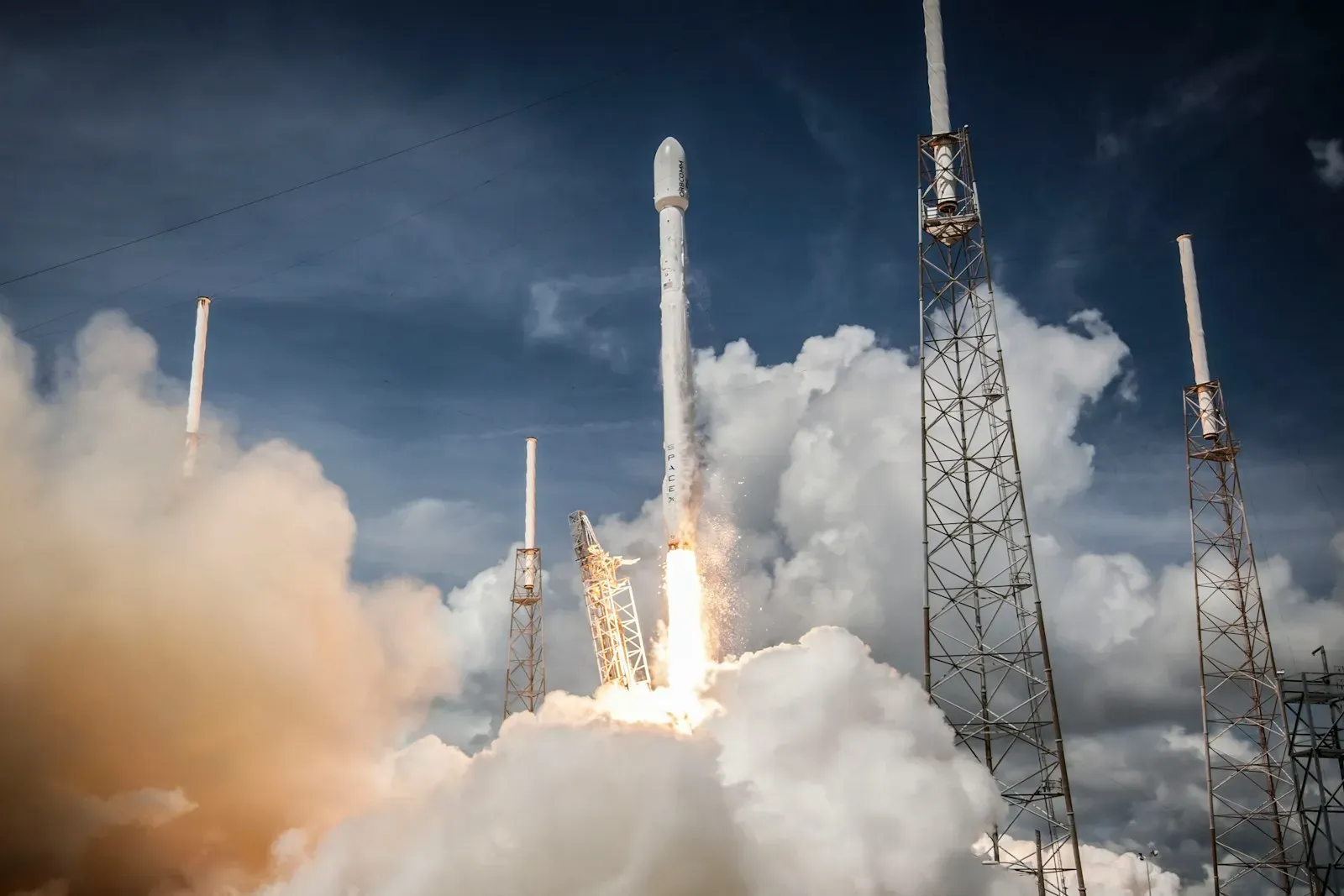
What rockets put in the sky
Not all rockets burn the same fuel, and the choice of propellant matters enormously for what ends up in our atmosphere. Let me walk through the main families.
Kerosene (RP-1) + Liquid Oxygen
This is the workhorse combination, powering the Falcon 9, Electron, and the venerable Soyuz. A single Falcon 9 launch burns roughly 155 tonnes of refined kerosene and produces 425 to 490 tonnes of CO2. For context, that’s about the annual car emissions of 500 French people packed into a few minutes of thunderous ascent.
But CO2 isn’t the real concern here. Kerosene is the largest source of black carbon (soot) among liquid-fueled rockets, depositing an estimated 5 to 20 tonnes of it directly into the stratosphere per launch. I’ll come back to why that matters.
Rocket Lab’s tiny Electron, by comparison, burns just 3.8 tonnes of propellant for roughly 10 to 12 tonnes of CO2. Scale matters.
Liquid Hydrogen + Liquid Oxygen
On paper, this sounds like the dream fuel: hydrogen plus oxygen gives you water vapor. Zero CO2 at the nozzle. NASA’s SLS core stage runs on this, as did the Ariane 5.
In practice, there’s a catch. SLS doesn’t fly on hydrogen alone. It relies on two massive solid rocket boosters burning over 1,260 tonnes of ammonium perchlorate propellant. Those SRBs emit roughly 230 tonnes of hydrochloric acid and 180 tonnes of aluminum oxide per launch, both of which are ozone-depleting. Even the water vapor itself, when injected directly into the stratosphere, acts as a greenhouse gas, albeit a short-lived one with a 1 to 2 year residence time.
Hydrogen sounds clean on the brochure. The full picture is messier.
Methane + Liquid Oxygen
This is where the industry is heading. SpaceX’s Raptor engines on Starship and Blue Origin’s BE-4 on Vulcan both burn methane. The good news: methane produces 50 to 100 times less soot per kilogram of fuel than kerosene. For stratospheric pollution, that’s a meaningful improvement.
The bad news: Starship is absolutely massive. A full-stack launch burns roughly 1,350 tonnes of methane, producing approximately 3,600 to 3,700 tonnes of CO2. That’s 7 to 8 times more CO2 per launch than a Falcon 9, simply because of the vehicle’s scale. Vulcan Centaur is more modest at around 550 tonnes of CO2, but it’s also a much smaller rocket.
If someone were to build a small launcher using methane, we’d get the soot benefits without the massive CO2 penalty. But the economics of the industry aren’t pushing in that direction.
Solid Rocket Boosters
And then there are the solid rocket boosters, the dirtiest option by far. Their ammonium perchlorate composite propellant emits aluminum oxide, hydrochloric acid, CO2, water vapor, and nitrogen oxides. Each kilogram produces about 0.17 kilograms of HCl, which participates directly in the same chlorine catalytic cycles that made CFCs infamous. The aluminum oxide particles also serve as nucleation sites for polar stratospheric clouds, enabling further ozone destruction.
The silver lining is that solid boosters are falling out of favor. The trend toward reusable liquid engines is making them increasingly rare on modern launch vehicles.
So, a rounding error?
Here’s where most articles on the topic stop: they compare rocket CO2 to other industries and declare it negligible. And in raw numbers, they’re right.
- Global aviation: roughly 1 billion tonnes of CO2 per year
- Global road transport: about 6 billion tonnes per year
- All rocket launches in 2024 (around 230 orbital attempts): approximately 70,000 tonnes of CO2, or about 0.007% of aviation
SpaceX’s 104 launches in 2024 produced roughly 47,000 tonnes of CO2, equivalent to about one day of transatlantic flights. So we’re done here, right? Rockets are a rounding error?
Not quite. Because raw CO2 is a red herring.
Why altitude changes everything
Ross and Sheaffer demonstrated back in 2014 that stratospheric soot is roughly 500 times more warming per unit mass than ground-level soot. When you emit CO2 at sea level, it mixes into the atmosphere and gets processed through normal carbon cycles. When you deposit black carbon at 20 to 40 kilometers altitude, it sits there for 3 to 5 years because there’s no rain to wash it out. Those particles absorb solar radiation, heat surrounding air, and alter atmospheric circulation patterns.
Comparing rocket emissions to aviation by weight alone is like comparing a campfire to a lit match inside a powder keg. The mass isn’t the point. The location is everything.
The soot problem
This is what actually keeps atmospheric scientists up at night. Maloney and their colleagues estimated that rockets deposited about 41 tonnes of black carbon in the stratosphere in 2019 alone. That sounds small, but the radiative forcing it produces is disproportionate to its mass.
Ryan and their colleagues modeled what happens if launch rates increase tenfold, a scenario that’s looking increasingly plausible. Their findings: soot accumulation could cause measurable hemispheric warming, up to 0.5 degrees Celsius at polar regions in worst-case scenarios. Dallas and their colleagues’ comprehensive review reached the same conclusion: black carbon and alumina particles are the two most concerning rocket emissions, not CO2.
This is precisely why the shift to methane engines matters. Even though Starship produces more CO2 per launch than Falcon 9, the dramatic reduction in stratospheric soot may make it a net improvement for the atmosphere. The irony of producing more CO2 while being cleaner overall is the kind of counterintuitive result that makes this topic so tricky for public discussion.
The ozone question
Soot isn’t the only stratospheric concern. Each Space Shuttle launch deposited about 68 tonnes of HCl and 57 tonnes of aluminum oxide in the stratosphere. That chlorine participates in the exact same catalytic cycle that the Montreal Protocol was designed to stop for CFCs.
Ryan and their colleagues’ modeling suggests that at 10 times 2019 launch rates, we’d see a 0.5 to 1% reduction in the global ozone column, with larger depletions of 2 to 4% near the poles. Larson and their colleagues separately modeled a fleet of reusable kerosene launchers and found localized ozone depletion of 1 to 2% at launch latitudes.
Here’s what I find particularly troubling: rocket emissions are simply not regulated by the Montreal Protocol. There is currently no international regulatory framework governing cumulative stratospheric pollution from launches. The Outer Space Treaty of 1967, our primary governance document for space activities, doesn’t address atmospheric emissions at all.
We built a remarkably effective regime to protect the ozone layer, and simply left out the one industry whose emissions go directly where they do the most damage.
Beyond the exhaust plume
The environmental story doesn’t end at the nozzle. There’s a broader picture that deserves attention.
Launch sites themselves take a toll. SpaceX’s first Starship test flight in 2023 scattered concrete debris across an adjacent wildlife refuge and ignited brush fires. The U.S. Fish and Wildlife Service has raised formal concerns. Decades of solid motor operations at Cape Canaveral and Vandenberg have left documented perchlorate contamination in groundwater, a known thyroid disruptor.
Then there’s what happens when all those satellites come back down. Murphy and their colleagues found in 2023 that metals from spacecraft reentry now constitute roughly 10% of stratospheric aerosol particles. If Starlink grows to its planned 42,000 satellites with 5-year lifespans, that’s about 8,400 reentries per year, each depositing aluminum oxide in the upper atmosphere. No regulations currently govern this either.
What we get back
Before reaching any conclusions, I think it’s essential to weigh what we get in return. And the answer is: quite a lot.
Climate science itself depends on satellites. Sea level monitoring (Sentinel-6), ice sheet tracking (GRACE-FO), atmospheric CO2 measurement (OCO-2), deforestation surveillance (Landsat, Sentinel-2). The Global Climate Observing System identifies 54 Essential Climate Variables, most of which require satellite observation. Without rockets, our understanding of climate change would be severely degraded.
Weather satellites like GOES and Meteosat are estimated to prevent roughly $10 billion per year in disaster losses in the US alone. GPS routing saves an estimated 6.2 billion gallons of fuel annually in the United States, with maritime shipping gaining 3 to 5% fuel efficiency per voyage and precision agriculture cutting fuel and fertilizer use by 10 to 15%.
Brazil’s DETER deforestation monitoring system, built on satellite data, contributed to a 70% reduction in Amazon deforestation between 2004 and 2012. MethaneSAT, launched in 2024, now maps global methane emissions at unprecedented resolution. The Paris Agreement’s monitoring framework would be crippled without satellite data.
I find it genuinely ironic that some of the most powerful tools we have for understanding and fighting climate change are delivered by the very vehicles whose environmental impact we’re questioning. All this is not even taking into account the other scientific breakthrough you use everyday from NASA: Velcros, Memory foam matresses, Water purifier…
Where this is headed
The 10x scenario
This is where the math starts to get uncomfortable. In 2024, we saw roughly 230 orbital launches globally. Projections for 2030 suggest 500 to 1,000 or more, driven by Starship, New Glenn, Neutron, Ariane 6, and a growing fleet of Chinese commercial launchers.
If Starship alone achieves 100 flights per year, that’s 370,000 tonnes of CO2 from a single vehicle type, five times the entire 2024 global rocket CO2 output. Satellite reentry scales proportionally: a full Starlink constellation with 5-year satellite lifespans means thousands of reentries annually, each depositing metal oxides in the stratosphere.
We went from a few dozen launches per year to a few hundred in the span of a decade. Going from hundreds to thousands is the next step, and we have essentially no governance framework prepared for it.
The verdict
Today, rockets are a rounding error for global CO2 but an outsized contributor to stratospheric pollution: soot, alumina, hydrochloric acid, and increasingly, metal oxides from satellite reentry. The raw CO2 comparison to aviation, while technically accurate, fundamentally misses the point. Altitude of deposition is everything.
The shift to methane engines is genuinely helping with soot, even if the CO2 numbers look worse on paper. Solid rocket boosters are declining. These are positive trends.
But at the projected growth rates, what is currently negligible transitions into potentially significant territory for ozone depletion and regional climate effects. Meanwhile, the satellites these rockets carry provide irreplaceable tools for climate monitoring, disaster prevention, and resource efficiency.
I believe the net environmental balance is still positive. The benefits of space infrastructure, from climate science to GPS fuel savings, likely outweigh the atmospheric costs. But that margin is shrinking as launch cadence accelerates, particularly for commercial applications like broadband constellations whose environmental necessity is harder to argue.
What worries me most isn’t the pollution itself, but the absence of any serious regulatory conversation about it. We need clear emissions standards for launch vehicles, mandatory environmental assessments that account for stratospheric deposition, and international agreements that close the gaps in the Montreal Protocol and Outer Space Treaty. The space industry proved with reusability that it can innovate when the incentives are right. It’s time to make cleaner launches one of those incentives.
This concludes the space race series, at least for now. Space exploration clearly gives humanity extraordinary benefits, but like any powerful endeavor, it demands responsible stewardship. The question was never whether rockets pollute. It’s whether we’re paying attention.