Film photography made me enjoy taking photos again
A year ago, I set myself a challenge to get back into photography.
Not because I had stopped caring about photos, but because I had started to dislike the process. Digital photography is amazing at many things, but it also comes with a trap: you can take as many pictures as you want. Burst a scene into oblivion, come back home, then spend an evening (or three) sorting, picking, and editing.
I don’t hate editing. I just don’t want it to be the main event. I like the act of taking pictures. The walking, the waiting, the framing, the little decisions you make in half a second. Somewhere along the way, I had lost that.
And then, by complete luck, I bought a disposable film camera for a vacation. It was the perfect antidote. A throwaway camera you can keep in your pocket, pull out for a random shot, and not worry about. If you lose it, you shrug. If you get a weird frame, you accept it. The pictures came back looking… not great, objectively (plastic lens, questionable sharpness…), but they had a thing. A built-in aesthetic you have to get on board with. Most importantly: I didn’t edit them.
That was enough to hook me back. I decided to get back into photography, but this time through film.
The challenge (and the part where I failed)
Because I know I’m lazy, I needed a constraint. So I made it public: I would post a picture on my website every day for a year.
Did I achieve it?
No. I failed miserably.
But I did shoot again. I carried a camera again. I made images I’m genuinely proud of. And that alone made the year worth it.
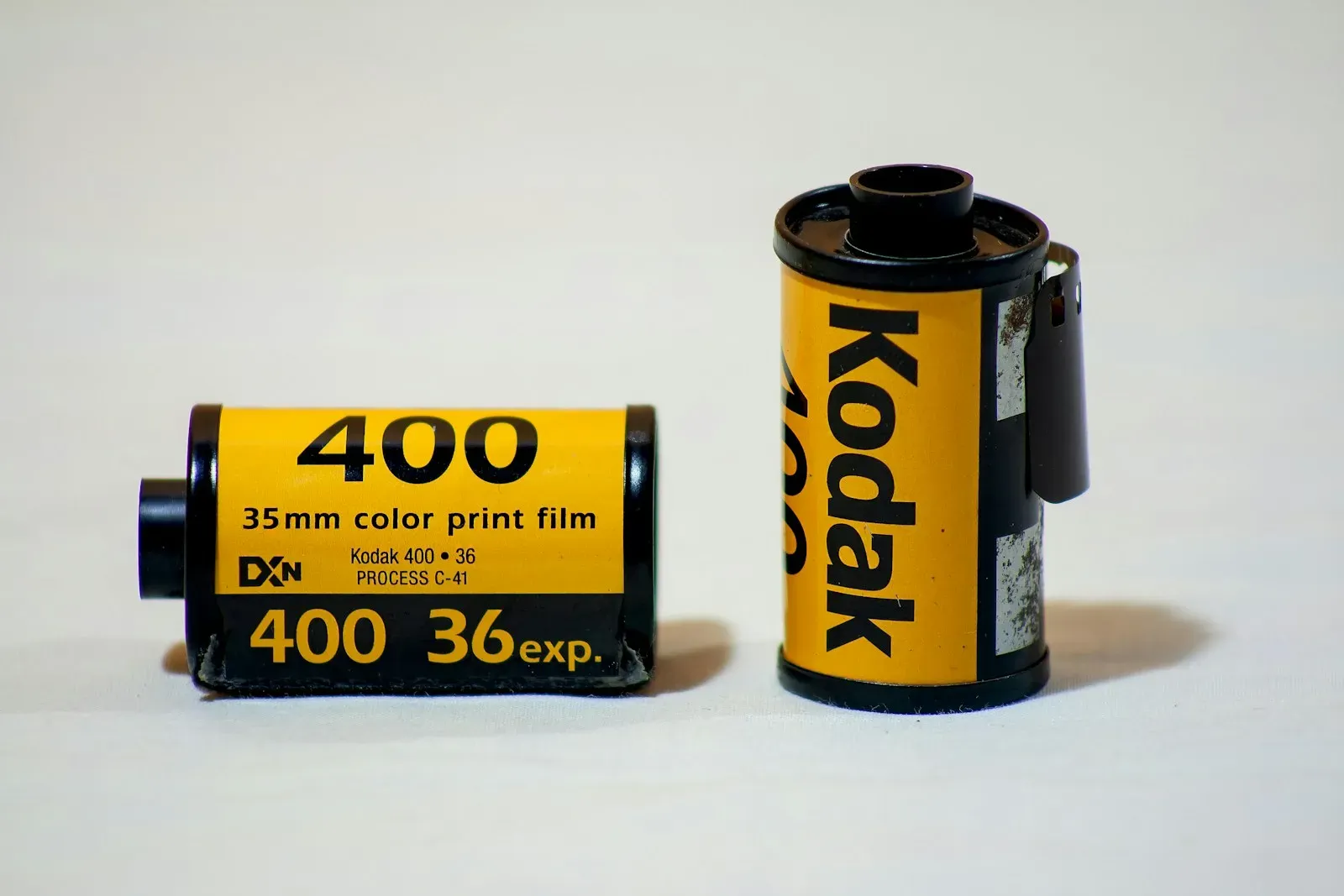
Over that year, I shot 22 rolls of film. Four were black and white. Seven were Kodak Gold. The rest were Vision film (the cinema stock, more down below). It’s not a lot for a “daily” challenge, but it was a real restart, and it brought back something I had missed: enjoying photography while doing it.
Starting cheap: the €30 camera that almost worked
Film is funny like that: it’s often cheap to start. I began with a small, old camera that cost me around €30. New film cameras are rare, and many are overpriced, so I did what most people do: I bought something old and simple.
It was a Ricoh 35ZF. Zone focusing, a compact body, a 40mm lens, a tiny light meter, and shutter speed priority. It was light, easy, and genuinely fun. I didn’t have to think too hard about metering. I could just… walk and shoot.
But it had one drawback that slowly became impossible to ignore: zone focusing. Zone focusing is great when you’re shooting street scenes in daylight or landscapes where “close enough” is what you are looking for. The moment you try to photograph people, or anything where focus placement matters, you’re basically guessing. And if you’re like me, you’re wrong often enough to get frustrated.
So I changed direction.
Falling in love with SLRs (despite a Soviet detour)
At some point I was gifted a Zenit 11, a gigantic Soviet-era camera. It was hilarious and charming and deeply mechanical in a way modern devices aren’t. It also had a problem: every photo came out blurry, because of some aging mirror mechanism. So it wasn’t a great tool.
But it taught me something important: composing through an SLR, seeing what’s in focus (and what isn’t), is incredibly satisfying. It makes photography feel direct again.
So I bought a Spotmatic SP1000, refurbished and serviced by a camera store, with a working light meter. I reused the lens from the Zenit, added another lens, and suddenly, with about €260 more, I had a little bundle of gear that actually worked very reliably.
It’s a steep upgrade when you think about its age, but compare it to modern camera pricing and you realize: ~€300 for two cameras and two lenses is still a pretty accessible way to get started, but here comes the catch.
Film is cheap to start. Then it starts billing you.
The cameras are the easy part. The real cost of film photography is not the body you buy once, it’s the rolls you keep feeding it.
Let’s talk black and white first.
A roll can be around €6. Development around €8. If you want scans (even low-res), add around €6. You’re now close to €20 per roll just to get something you can actually use and share. Multiply that by the ~20 rolls I shot, and suddenly film doesn’t feel like a “cute hobby” anymore at around 400 euros.
And color is worse. The cheapest color film you’ll find in regular shops, Kodak Gold or ColorPlus, often sits around €10 per roll. If you want something “nicer” or just different, like Portra, it can hit €20 very quickly.
At that point, yes: your digital camera starts looking attractive again. So if you want to shoot film without constantly thinking about money, you need a plan.
Three levers to make film cheaper (without killing the fun)
In my experience, there are three places where you can meaningfully reduce cost:
1) The film itself
For black and white, the advice is boring but effective: buy the cheap stocks. Kentmere and Fomapan are usually great value, and you can shoot a lot without feeling like every frame is a luxury purchase.
Color is where things get painful. I find the entry-level stocks can be fun, but also limiting: the grain can be heavy, the colors can lean “retro” (which you might love), and they’re not always what I want.
A great hack here is Vision3 film, cinema film meant for the movie industry. It’s often sold as repackaged / hand-rolled 35mm rolls. You’ll see it under names like 250D or 500T depending on the stock. You can buy it in bulk and roll it yourself (the hand-roller is about €80), or buy it already rolled from smaller sellers for around €8 a roll. At around €8 a roll, you save 2 euros and get better quality.
One important warning: Vision3 generally requires ECN-2 development, not standard C-41. So before you buy a stack of it, check that your lab can actually process it, or plan to do it yourself.
2) Scanning
Low-cost lab scans are often… fine. But they’re also often too low-quality to do anything with. If you want to remove dust, fix a small exposure issue, or simply have images you’re proud to archive, you quickly get pushed toward expensive high-res scans.
Scanning is a great candidate for DIY: A second-hand Plustek (for 35mm) or an Epson flatbed can pay for itself surprisingly fast if you shoot regularly. Another option is camera scanning with an old digital body and a cheap macro-ish setup.
This is what I do now. I’m not sure I’ve fully “paid back” the scanner yet, but the quality jump alone made it worth it, and from a certain number of rolls onward, it becomes a straight saving.
3) Developing
Developing is the final lever, and it’s the one people fear the most… even though black and white development is genuinely approachable.
For black and white, you need a tank, some bottles, chemicals, and time. Temperature control is forgiving. After the initial gear, your per-roll chemical cost can drop to something like €0.50 (or less). The break-even point can be shockingly low, on the order of ~10 rolls, depending on your local lab prices.
Color is trickier.
C-41 at home works, and you’ll save money, but usually not enough to justify it unless you shoot a lot. The chemistry cost per roll tends to be a couple euros, and the setup adds time, temperature constraints, and upfront spending.
ECN-2, on the other hand, can make sense because labs often charge more for it (or don’t offer it). If you want to shoot Vision3 to save money, but your lab charges double for ECN-2, you’ve defeated the point. In that case, developing yourself can bring the whole “Vision is cheaper” idea back into reality.
Personally, I’ve been lucky: I have access to a lab that does ECN-2 for the same price as C-41. But I might move, and then I won’t. Which is why I’m considering developing ECN-2 myself.
The conclusion I didn’t expect
At the end of this year-long experiment, I spent roughly €600 on everything: equipment, film, development, scanning. It sounds like a lot when you say it out loud.
And yet, it bought me a year of photography that I actually enjoyed. I didn’t complete the daily challenge I fixed myself, but I did restart a habit. I learned what I like: smaller cameras, fewer decisions, less editing, more shooting. I also learned that film photography is both more accessible and more expensive than people think: cheap to start, costly to sustain, unless you take control of a few parts of the pipeline.
Will I continue posting every day? Probably not.
Will I keep shooting film, especially when I travel, especially when I want the process to feel simple again? Yes.
And if you’ve felt the same quiet fatigue with digital, if you miss the feeling of taking photos more than the feeling of polishing them, film might be the reset you’re looking for.